
Marketing
Broadcasts
Send one message to many contacts, at a safe speed.
Start a new broadcast
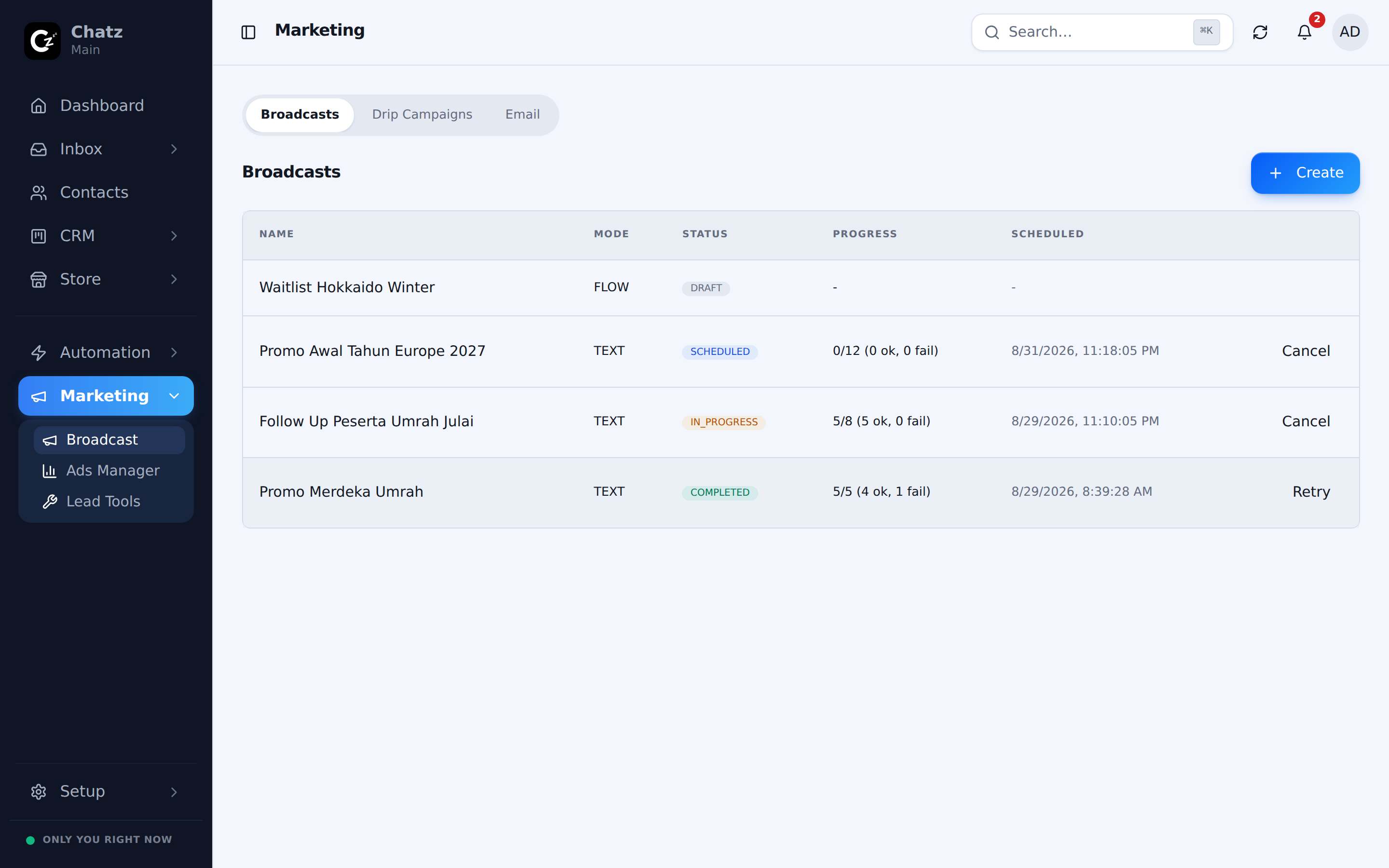
A broadcast sends one message to many contacts at once, the fastest way to reach your whole list about a promotion, an update or a reminder. Open Marketing then Broadcast and press New broadcast.
- Name the broadcastA label for your own reference, shown in the broadcast list and its progress screen.
- Pick the channelChoose which connected channel sends the message. Some message types depend on this choice, since a WABA template can only go out on a WhatsApp Business API channel.
- Write the bodyAdd merge tags, such as a contact's name, so the message still feels personal at scale.
Choose a message type
The type you pick decides what the dialog asks for next.
| Type | What it sends |
|---|---|
| Text message | A plain message with merge tags, sent directly. |
| Flow | Enrols every recipient into an automation flow, so the broadcast can branch, wait and follow up rather than sending one line. |
| WABA template | A pre-approved WhatsApp Business API template, the only type allowed once a customer is outside the 24-hour service window. |
For more on templates and the 24-hour window, see WhatsApp Business API. For what a flow can do once someone is enrolled, see Message flows.
Pick your audience
Send to all your contacts, or narrow the list to one or more tags, for example only contacts tagged VIP or Interested, Not Booked. Tags are managed under Tags and tag groups, so build the audience there first if the segment you want does not exist yet.
Sending speed and safety
A broadcast does not send every message at once. You choose a sending speed preset, and each preset shows a risk badge next to its throughput in messages per minute, so you can see the trade-off before you launch.
A WhatsApp Business API channel is hosted by Meta, so the ban risk a slower preset guards against does not apply there in the same way, but a sensible pace still keeps delivery smooth.
Preflight checks and progress
Before a broadcast launches, Chatz runs preflight checks, catching problems with the message, the audience or the channel before anything sends, rather than partway through.
- Once launched, the broadcast shows per-recipient progress: sent, delivered and failed.
- A failed send can be reviewed alongside your other failures under Scheduled and failed messages.